


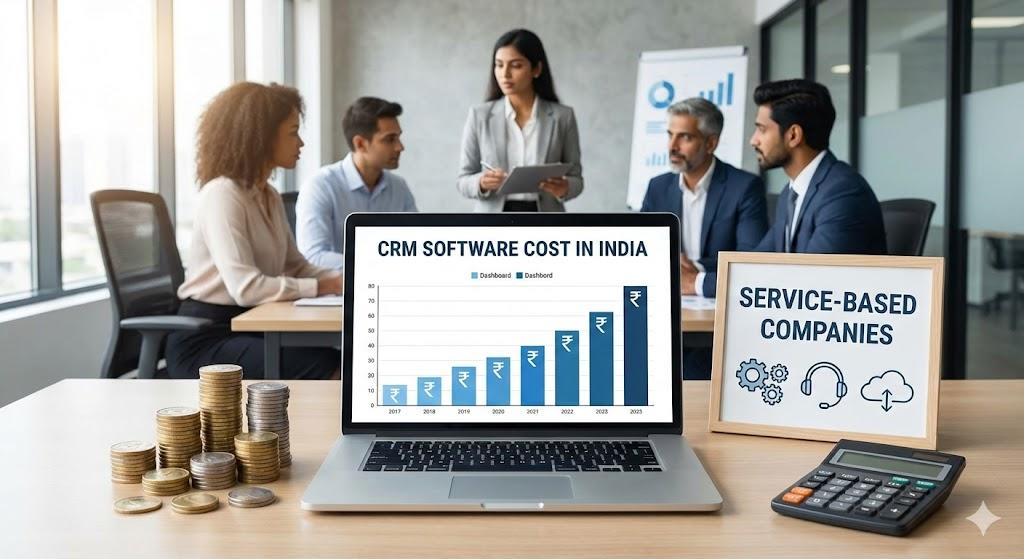
Introduction
For service-based companies — consultancies, agencies, clinics, repair services, professional services, and field teams — a CRM is no longer optional. It centralizes client records, schedules work, tracks service SLA,s and automates recurring communications. But before you pick a product, you need a realistic budget. This guide explains the components that drive service business CRM cost in India, gives concrete price examples from leading vendors, outlines implementation and ongoing costs, and presents sample budgets you can adapt for your business size.
1. What contributes to CRM cost for service businesses?
CRM cost has two broad parts:
-
Software (licensing/subscription) — per-user or per-seat SaaS fees, or an enterprise license if you self-host.
-
Implementation & operational costs — one-time or recurring costs for setup, customization, integration, data migration, training, support, and add-ons (e.g., telephony, analytics, AI).
For service businesses, some line items are especially important: scheduling/calendar integrations (field service), ticketing/SLAs, billing/quote generation, and integrations with accounting/payments and timesheets. These drive extra configuration and sometimes require higher-tier plans or paid add-ons.
2. Typical SaaS license price ranges (real vendor examples)
Below are representative commercial prices from major CRM vendors that Indian service businesses commonly evaluate:
-
Zoho CRM (India): Zoho publishes Indian-rupee pricing for its tiers; for example, Zoho’s paid plans show prices in the ₹800–₹3,200 per user/month band (billed annually for specific tiers). Use Zoho when you need Indian invoicing, localized support,t and good value for small-to-midsize service teams.
-
Freshworks / Freshsales (Freshworks CRM): Freshworks offers a free tier and paid plans that start in the low-single-digit USD range per user/month (Growth/Pro/Enterprise scale up by feature). It’s positioned for teams that want straightforward sales + service automation with easy onboarding.
-
Salesforce: Enterprise-grade and highly extensible — Salesforce lists global per-user prices (Sales Cloud / CRM bundles) in the tens to hundreds of USD per user/month depending on edition and add-ons; India-specific enterprise offers occasionally apply through the India site and partners. Expect higher licensing costs for complex Salesforce deployments than for native Indian SaaS products.
-
HubSpot CRM: HubSpot provides a fully functional free CRM tier (useful to start) with premium Sales/Service Hubs for advanced automation and reporting when you scale. Free tier capabilities and paid tiers make it an option for service teams who value marketing and service alignment.
Practical takeaway: entry-level SaaS CRMs suitable for small service teams commonly cost the equivalent of a few hundred to a few thousand rupees per user per month; enterprise/feature-rich platforms (and specialist field-service modules) can cost materially more.
3. Implementation, customization, and integration — the real cost drivers
Subscription fees are only part of the story. For a service business, expect additional one-time or staged expenses:
-
Consulting & implementation: basic setups (user accounts, templates, workflows) can be modest; mid-level projects (custom modules, business rules, field service scheduling) cost more. Published industry guidance shows implementation can range from a few thousand USD for straightforward projects to tens of thousands for complex rollouts. Consultant hourly rates in India vary by seniority — many sources report junior consultants at modest hourly rates and senior specialists at significantly higher rates. Plan immediately for consulting budget if you need custom automations or integrations.
-
Integrations: connecting CRM to accounting (Tally/QuickBooks/Xero), payment gateways, ERP, telephony, or field-service apps increases scope. Simple API or native integrations may be low cost; custom API work can materially raise the budget.
-
Data migration: cleaning and migrating historical client data, contracts, and invoices is labor-intensive; costs depend on data volume and quality.
-
Training & change management: time and effort to onboard users — include internal training sessions, process documentation, and a support phase after go-live.
-
Ongoing support & maintenance: payroll for an internal admin or a support retainer with the vendor/partner for updates, security, and new workflows.
Example ranges (indicative):
-
Minimal implementation (small business, out-of-the-box): ₹20,000–₹75,000 one-time.
-
Moderate implementation (custom workflows, 2–3 integrations): ₹1.5 lakh–₹6 lakh.
-
Complex enterprise rollout (deep ERP integrations, custom development, multi-region rollouts): ₹10 lakh+ and up (or $10k–$100k+ depending on scope). These ranges draw on recent implementation analyses and consultant rate surveys.
4. Ongoing & hidden costs to budget for
-
Per-user subscription (monthly/annual) — main recurring line.
-
Storage/contact thresholds/add-ons — some vendors charge for contacts, additional storage, or premium AI features.
-
Premium support — faster SLA, dedicated CSM.
-
Upgrades & custom development — iterative improvements after go-live.
-
Third-party connectors or middleware — e.g., Zapier, Make, or an iPaaS for complex integrations.
Plan operating budget for at least 12–18 months of subscription + 10–25% of the initial implementation cost as annual upkeep.
5. Sample budget scenarios for service businesses (cost estimates you can adapt)
Below are three realistic scenarios built around typical vendor options (use these as starting templates for service business crm cost in India planning).
A. Micro service business — 3–7 users (e.g., local consultancy/repair shop)
-
Software: Zoho Standard at ₹800/user/month × 5 users ≈ ₹4,000/month (₹48,000/year).
-
Implementation: basic setup + training ≈ ₹20,000–₹50,000 one-time.
-
Integrations: use native connectors or Zapier — ₹0–₹10,000.
-
Estimated first-year total: ₹70,000–₹1,20,000.
B. Small-to-mid service firm — 10–30 users (agency, managed services, clinic chain)
-
Software: Mid-tier (Zoho Professional/Enterprise or Freshworks Pro). If Freshworks Growth/Pro is chosen, expect a per-user US$9–39/month range (convert locally or buy through Indian billing). Use native Indian pricing where available for exact INR.
-
Implementation: customization, 1–3 integrations, workflows ≈ ₹1.5 lakh–₹6 lakh.
-
Training & change management: ₹25,000–₹1.5 lakh.
-
Estimated first-year total: ₹4 lakh–₹18 lakh (depending on vendor, number of integrations, and depth of customization).
C. Enterprise-grade service company — 50+ users (multi-location professional services)
-
Software: Salesforce or equivalent (higher per-user licensing + optional Service Cloud/Field Service). Salesforce lists per-user pricing by edition; large deployments often use professional services partners and negotiated enterprise contracts.
-
Implementation & integration: ₹10 lakh–₹50 lakh+ depending on ERP, custom development, and regulatory needs.
-
Ongoing support & enhancements: annual retainer or internal team (significant).
-
Estimated first-year total: ₹20 lakh–₹2 crore+ depending on complexity and scale.
6. How to reduce CRM cost without losing value
-
Start small and phase features: launch with essential modules (contacts, pipeline, service tickets) and add integrations later.
-
Choose native integrations first: native connectors are cheaper than custom APIs.
-
Buy annual licenses: many vendors (including Zoho) give discounts for annual billing.
-
Use vendor-free tiers while piloting: HubSpot and others offer free CRMs to validate processes before paying.
-
Use a blended implementation team: combine local junior consultants for routine work and experienced specialists only where needed (sensible for India, where hourly rates vary by seniority).
-
Negotiate enterprise discounts: for larger user counts, vendors and partners often provide India-specific offers or partner discounts.
7. Decision checklist for service businesses (what to confirm before budgeting)
-
How many active users will need access? (include admins and managers)
-
Which systems must the CRM integrate with (accounting, field apps, telephony, payments)?
-
Do you require field-service scheduling or on-site job tracking?
-
Expected data migration volume and cleanliness.
-
Regulatory/compliance needs for data residency or audits.
-
Preference for Indian-billed invoices or global billing.
Answering these determines whether a low-cost SaaS plan suffices or whether you must budget for an enterprise grade rollout.
Conclusion — realistic budgeting for service business crm cost in India
Licensing for a service business CRM in India can start as low as a few thousand rupees per month for a small team (using value SaaS like Zoho) and scale up to substantially larger budgets for enterprise platforms (Salesforce, heavily customized deployments). Remember: subscription fees are predictable, but implementation, integrations, and support are where most projects exceed initial expectations. Use the sample budget scenarios above to map your expected first-year total, and ensure you allocate 10–25% of implementation value for ongoing maintenance.
If you would like, I can prepare a tailored first-year cost estimate for your business: tell me the number of CRM users, three must-have integrations (example: accounting, payments, field scheduling), and whether you prefer an Indian-billed vendor (Zoho/Freshworks) or an enterprise vendor (Salesforce/HubSpot). I’ll produce a concise cost breakdown (licensing, implementation, first-year total) you can take to stakeholders.

 English
 Arabic
 French
 Spanish
 Portuguese
 Deutsch
 Turkish
 Dutch
Dutch
 Italiano
 Romaian
 Portuguese (Brazil)
 Tiếng Việt