


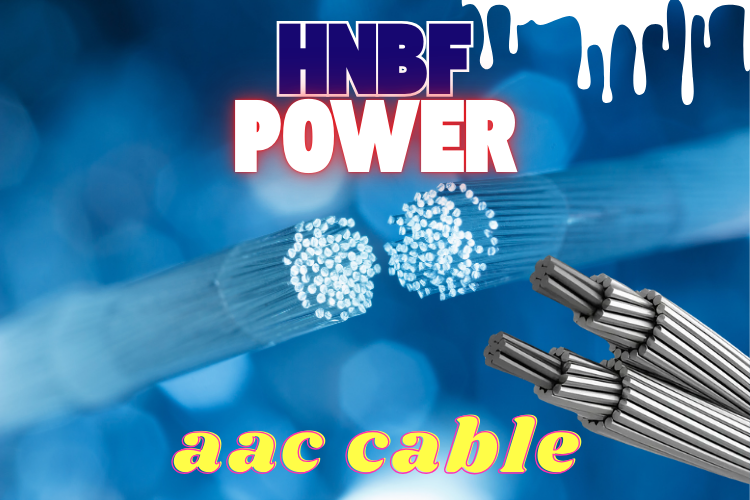
AAC cable, short for All Aluminum Conductor, is one of the most widely used overhead conductors in electrical power distribution systems. Known for its excellent conductivity, lightweight structure, and cost efficiency, AAC cable is commonly selected for urban power networks, substations, short-span transmission lines, and distribution applications where high conductivity and corrosion resistance are critical.
As a global manufacturer of overhead conductors and power cables, HNBF Power supplies high-quality AAC cables engineered to meet international utility standards and the demanding requirements of modern power infrastructure projects.
What Is an AAC Cable?
An AAC cable consists of multiple strands of high-purity aluminum wires concentrically stranded to form a conductor. Unlike ACSR or AAAC, AAC contains no steel core or alloying elements, making it a pure aluminum conductor with maximum electrical conductivity.
Key Construction Features
-
Made from EC-grade aluminum (typically 99.5% purity or higher)
-
Single-layer or multi-layer stranded design
-
Non-magnetic and lightweight
-
Smooth surface for reduced corona loss in distribution lines
Because of its material composition, AAC cable offers superior current-carrying capacity compared to alloy-based conductors of the same cross-sectional area.
Technical Advantages of AAC Cable
High Electrical Conductivity
AAC cables provide excellent conductivity due to their high aluminum purity. This allows utilities to achieve efficient power transmission with minimal electrical losses over short to medium distances.
Lightweight Design
Without a steel core, AAC cable is significantly lighter than ACSR. This reduces mechanical loading on poles and towers, making it suitable for:
-
Urban overhead distribution
-
Substations
-
Coastal and industrial environments
Corrosion Resistance
AAC conductors perform well in coastal, humid, and chemically aggressive environments. The absence of steel eliminates the risk of galvanic corrosion, extending service life in challenging climates.
Cost-Effective Solution
For applications where high tensile strength is not the primary requirement, AAC cable offers a cost-effective alternative while maintaining strong electrical performance.
AAC Cable vs Other Overhead Conductors
AAC vs ACSR
-
AAC: Higher conductivity, lower tensile strength
-
ACSR: Steel core provides higher mechanical strength for long spans
AAC is ideal for short-span distribution lines, while ACSR is preferred for long-distance transmission.
AAC vs AAAC
-
AAC: Better conductivity, lower strength
-
AAAC: Aluminum alloy provides higher tensile strength
Utilities often select AAC when electrical performance and corrosion resistance outweigh mechanical requirements.
Common Applications of AAC Cable
AAC cable is widely used across power distribution networks, especially in environments where strength demands are moderate.
Typical applications include:
-
Urban and suburban overhead distribution lines
-
Electrical substations and switchyards
-
Coastal power networks
-
Industrial plant distribution systems
-
Temporary or emergency power lines
HNBF Power manufactures AAC cables suitable for both standard and project-specific applications, supporting utilities and EPC contractors worldwide.
Standards and Quality Compliance
AAC cables are typically manufactured according to international standards such as:
-
ASTM B231 / B231M
-
IEC 61089
-
BS and other regional utility specifications
At HNBF Power, AAC conductors are produced under strict quality control processes, ensuring consistent strand geometry, accurate resistance values, and reliable mechanical performance. Each batch undergoes electrical, dimensional, and material testing before delivery.
Why Choose HNBF Power for AAC Cable?
HNBF Power is a trusted global supplier of overhead conductors and power cables, serving power utilities, grid operators, and infrastructure developers.
What Sets HNBF Power Apart
-
Advanced manufacturing facilities for AAC, AAAC, ACSR, and ABC cables
-
Consistent compliance with international standards
-
Flexible conductor sizing and stranding options
-
Technical support for conductor selection and project optimization
-
Reliable supply for large-scale transmission and distribution projects
Whether for grid expansion, network upgrades, or replacement of aging lines, HNBF Power delivers AAC cable solutions designed for long-term performance.
Selection Considerations for Engineers and Buyers
When specifying AAC cable, engineers and procurement teams should evaluate:
-
Span length and mechanical loading requirements
-
Environmental conditions (coastal, industrial, urban)
-
Required current-carrying capacity
-
Applicable utility or project standards
HNBF Power works closely with clients to ensure the AAC conductor selected aligns with both electrical performance needs and budget considerations.
FAQs About AAC Cable
1. What is the main advantage of AAC cable?
The primary advantage of AAC cable is its high electrical conductivity combined with excellent corrosion resistance, making it ideal for urban and coastal distribution networks.
2. Is AAC cable suitable for long transmission lines?
AAC cable is generally used for short to medium spans. For long-distance or high-tension lines, conductors like ACSR or AAAC are usually preferred due to higher tensile strength.
3. Can AAC cable be used in coastal areas?
Yes. AAC cable performs very well in coastal and high-humidity environments because it does not contain steel, reducing corrosion risk.
4. Does HNBF Power offer customized AAC cable sizes?
Yes. HNBF Power provides customized AAC cable configurations based on conductor size, stranding, and applicable standards to meet specific project requirements.
Conclusion
AAC cable remains a dependable and efficient solution for overhead power distribution where conductivity, corrosion resistance, and cost efficiency are essential. Its proven performance makes it a preferred choice for utilities and industrial power systems worldwide.
If you are planning a distribution or grid project and need reliable AAC cable solutions, contact HNBF Power today. Our technical team is ready to support you with customized conductor designs, competitive supply, and expert guidance for your power transmission and distribution needs.

 English
 Arabic
 French
 Spanish
 Portuguese
 Deutsch
 Turkish
 Italiano
 Russian
 Romaian
 Portuguese (Brazil)
 Tiếng Việt