


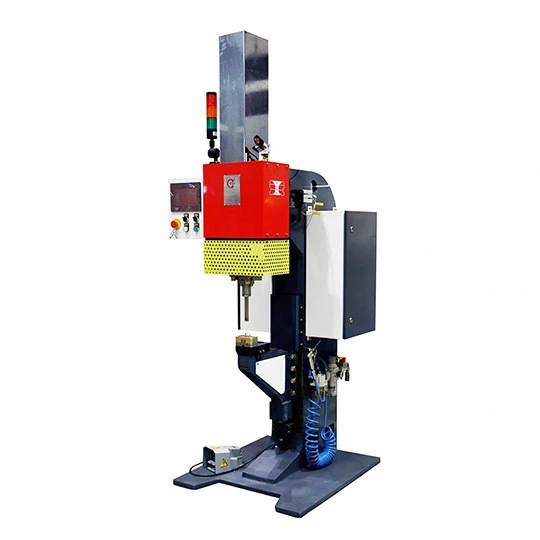
In today’s high-efficiency manufacturing environment, joining technologies must meet the demands of speed, strength, and precision. Self pierce riveting (SPR) has emerged as a leading solution for industries ranging from automotive to appliance manufacturing, offering robust metal-to-metal and multi-material joining without the need for pre-drilled holes or additional fasteners.
As a global manufacturer of industrial welding and metal-joining equipment, Heron Welder provides advanced SPR systems and automated production solutions designed for maximum productivity, reliability, and quality.
What is Self Pierce Riveting?
Self pierce riveting (SPR) is a mechanical fastening process in which a semi-tubular rivet is driven through the top sheet(s) of metal and flares into the bottom sheet without breaking or requiring pre-drilled holes. Unlike traditional riveting, the process forms a strong, permanent joint while preserving material integrity.
Key features of SPR include:
-
No pre-drilled holes required
-
Ability to join dissimilar materials (aluminum to steel, for example)
-
Minimal distortion in thin or coated sheets
-
High-speed automation compatibility
This combination of efficiency and versatility makes SPR a preferred method for OEMs and manufacturing engineers seeking lightweight, strong assemblies.
How Self Pierce Riveting Works
The SPR process involves three essential stages:
1. Rivet Positioning
The rivet is aligned over the joint area using a precision-controlled tool, either manually or via a robotic arm in automated lines.
2. Piercing and Flare Formation
A hydraulic or servo-driven punch drives the rivet through the upper sheet. The rivet’s lower portion flares into the lower sheet, creating a mechanical interlock.
3. Joint Completion
The rivet clinches the sheets together, producing a strong, durable connection. The process avoids heat-affected zones typical in welding, preserving material properties and coatings.
Heron Welder’s SPR machines offer precise control over rivet penetration depth, force, and alignment, ensuring consistent high-quality joints for industrial production lines.
Applications of Self Pierce Riveting
SPR is widely adopted across multiple sectors:
-
Automotive Industry: Joining lightweight aluminum and steel panels, body-in-white assemblies, and hybrid material structures.
-
Appliance Manufacturing: Securing metal panels and structural frames efficiently without pre-drilled holes.
-
Construction & HVAC: Joining thin-gauge metals, sheet metal ducts, and structural supports.
-
Electronics & Automotive Battery Enclosures: SPR enables assembly of coated or sensitive materials without heat damage.
By reducing cycle times and minimizing rework, SPR enhances production efficiency while maintaining structural integrity.
SPR vs. Traditional Joining Methods
Manufacturers often compare SPR to alternative joining techniques like spot welding, clinching, or adhesive bonding. Understanding the differences helps optimize production processes:
| Method | Key Advantage | Limitation |
|---|---|---|
| Spot Welding | Fast and strong | Not ideal for dissimilar metals; may distort thin sheets |
| Mechanical Clinching | No heat; joins coated metals | Lower joint strength compared to SPR |
| Adhesive Bonding | Distributes load; joins non-metals | Requires curing time; sensitive to surface prep |
| Self Pierce Riveting | Joins dissimilar metals; minimal distortion; high automation compatibility | Requires access from the top sheet only; rivet cost |
Heron Welder’s SPR solutions bridge the gap between speed, strength, and versatility, providing manufacturers with a reliable method to join complex assemblies efficiently.
Best Practices for Self Pierce Riveting
Implementing SPR successfully requires careful attention to equipment, materials, and process parameters:
-
Material Selection: Ensure rivets are compatible with the sheets’ hardness and thickness. Aluminum rivets are often used for lightweight structures.
-
Tooling Maintenance: Regular inspection of punches and dies prevents misalignment and rivet failures.
-
Process Optimization: Adjust rivet depth, force, and speed based on material combinations to achieve consistent joint quality.
-
Automation Integration: Robotic SPR systems enhance repeatability, reduce cycle time, and improve ergonomics in high-volume production lines.
-
Quality Control: Employ non-destructive testing (e.g., cross-section inspection) to verify joint strength and flare formation.
Heron Welder’s SPR equipment includes advanced control systems, allowing engineers to monitor parameters in real-time, ensuring optimal joint performance across every cycle.
FAQs About Self Pierce Riveting
Q1: Can SPR join aluminum to steel?
Yes, SPR excels at joining dissimilar materials like aluminum and steel without heat-related issues. This makes it ideal for lightweight automotive and aerospace applications.
Q2: Is pre-drilling required for self pierce riveting?
No, one of SPR’s main advantages is that it eliminates the need for pre-drilled holes, saving time and reducing production complexity.
Q3: How does SPR compare to spot welding?
SPR avoids heat-affected zones and distortion, making it suitable for coated or thin materials, while spot welding may cause localized warping and material degradation.
Q4: Can SPR be automated?
Absolutely. SPR systems are highly compatible with robotic automation, ensuring precise, high-speed assembly in industrial production lines.
Q5: What maintenance is needed for SPR machines?
Routine inspection of punches, dies, and hydraulic or servo systems ensures consistent rivet quality and reduces downtime.
Why Choose Heron Welder for SPR Solutions
At Heron Welder, we specialize in designing and manufacturing SPR machines tailored to industrial needs. Our systems combine:
-
High-precision riveting technology
-
Integrated automation solutions
-
Customizable controllers and tooling
-
Durable and low-maintenance construction
We support OEMs, factory managers, and automation integrators in implementing SPR processes that improve production speed, reduce costs, and maintain high-quality standards.
Conclusion
Self pierce riveting is transforming modern manufacturing by providing a reliable, efficient, and versatile method for joining metals and multi-material assemblies. Whether your focus is automotive body-in-white, appliance panels, or industrial metal fabrication, SPR offers unmatched benefits in speed, joint strength, and process control.
Heron Welder stands ready to provide customized SPR solutions, integrating advanced machines, automation, and tooling for maximum productivity.
Request a quote or consult with Heron Welder today to discover how our self pierce riveting systems can optimize your production line and deliver lasting results.

 English
 Arabic
 French
 Spanish
 Portuguese
 Deutsch
 Turkish
 Italiano
 Russian
 Romaian
 Portuguese (Brazil)
 Tiếng Việt