


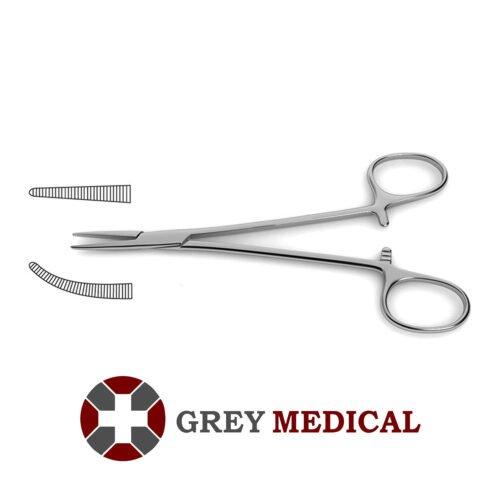
Surgical procedures demand precision, reliability, and tools that surgeons can trust implicitly. Among the vast array of instruments found in an operating theater, few are as universally recognized or as frequently utilized as the hemostat. Specifically, smaller variations like the Halstead Mosquito Clamp play a pivotal role in maintaining a clear surgical field and ensuring successful outcomes.
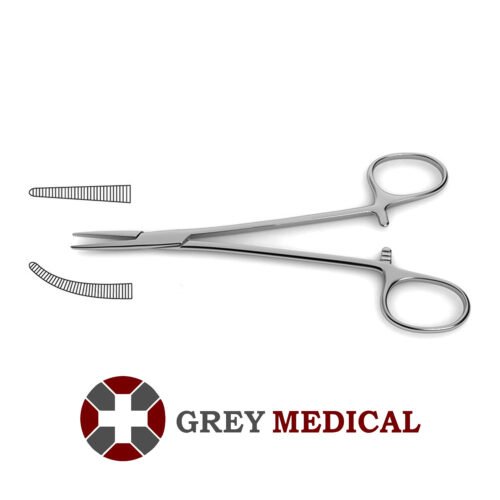
What Defines a Halstead Mosquito Forcep?
The Halstead Mosquito Clamp is a small, ratcheted hemostat used primarily for clamping small blood vessels. Named after William Stewart Halsted, a pioneering American surgeon who introduced several principles of modern surgery, these clamps are designed for delicate work. Unlike their larger counterparts, such as Kelly or Crile forceps, mosquito clamps are typically smaller, usually measuring around 5 inches in length.
They feature serrated jaws that can be either straight or curved. The serrations allow for a firm grip on tissue or vessels without causing excessive trauma. The locking mechanism, or ratchet, near the finger rings allows the surgeon to clamp the instrument in place, freeing up their hands for other tasks. This self-retaining capability is crucial during intricate procedures where controlling bleeding from multiple small points is necessary.
Clinical Applications and Versatility
Versatility is a key attribute of any great surgical tool. While primarily used for hemostasis—stopping the flow of blood—the Halstead Mosquito Clamp finds utility in a variety of other surgical contexts.
Delicate Tissue Handling
In plastic and reconstructive surgery, where tissue handling must be exceptionally gentle to minimize scarring, these clamps are often the instrument of choice. Their fine tips allow surgeons to grasp and manipulate delicate tissues with a high degree of control.
Pediatric and Veterinary Surgery
Due to their small size, these clamps are indispensable in pediatric surgery where anatomical structures are significantly smaller. Similarly, veterinary surgeons frequently rely on the medical forceps for procedures on small animals, where standard instruments would be too cumbersome or aggressive.
Blunt Dissection
Beyond clamping, the fine nose of the instrument is often used for blunt dissection. Surgeons can insert the closed tips into tissue planes and gently open them to separate structures without cutting, preserving nerves and blood vessels.
The Importance of Quality Manufacturing
Not all surgical instruments are created equal. The effectiveness of a surgical tool relies heavily on the quality of the steel and the precision of the craftsmanship. A poorly made clamp may fail to lock securely or could have misaligned jaws that tear tissue rather than holding it.
This is where GreyMedical® stands apart. As a privately owned medical technology company dedicated to innovation and excellence in the craft of surgical instruments, GreyMedical® understands that a surgeon's skill is only as good as the tools in their hands. Their commitment ensures that every Halstead Mosquito Clamp they produce meets rigorous standards for durability, balance, and precision. When lives are on the line, the reliability of a simple clamp becomes a matter of paramount importance.
Conclusion
From the emergency room to the specialized operating theater, the ability to control bleeding and handle tissue delicately is fundamental to surgical success. The Halstead Mosquito Clamp remains a staple in surgical trays worldwide because it performs these basic functions with unmatched reliability. Whether you are a medical student learning the basics of instrumentation or a seasoned surgeon, recognizing the value of high-quality tools like those from GreyMedical® ensures that patient care remains the top priority.

 English
 Arabic
 French
 Spanish
 Portuguese
 Deutsch
 Turkish
 Dutch
Dutch
 Italiano
 Romaian
 Portuguese (Brazil)
 Tiếng Việt