


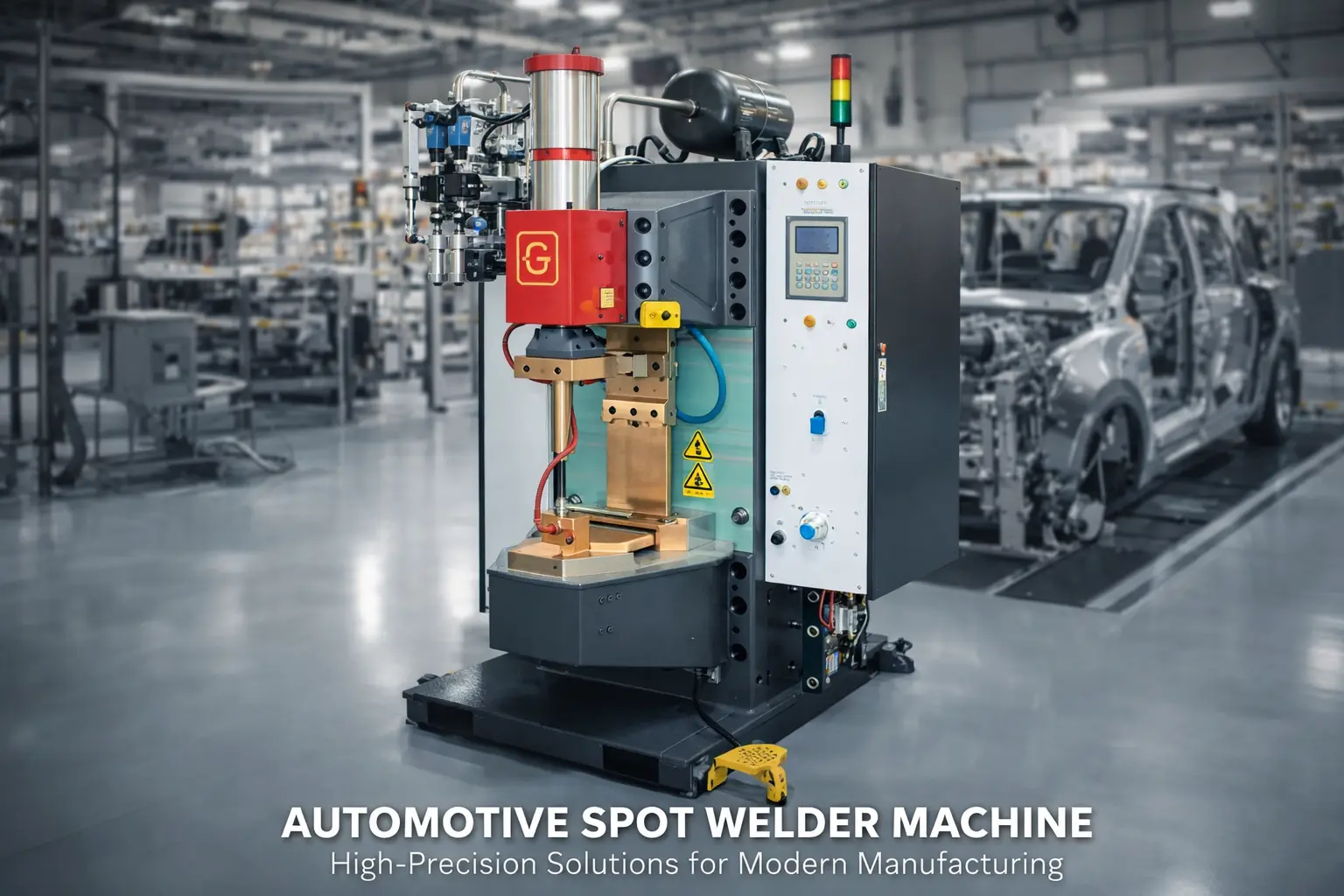
In modern automotive manufacturing, precision, speed, and repeatability define production efficiency. Among all joining technologies, the automotive spot welder remains one of the most widely deployed systems for assembling vehicle body structures, especially in high-volume OEM production lines. From body-in-white (BIW) assembly to battery enclosures in EV platforms, resistance spot welding is the backbone of sheet metal joining in the automotive sector.
This article explains how automotive spot welders work, where they are used, their advantages over other joining methods, and how engineers can optimize welding performance in automated production environments.
What is an Automotive Spot Welder?
An automotive spot welder is a resistance welding system designed to join overlapping metal sheets using controlled heat and pressure at localized points. It uses copper electrodes to apply force and electrical current, generating heat at the interface of the sheets until a weld nugget is formed.
This process is fundamental in automotive production because it is:
- Extremely fast (milliseconds per weld)
- Highly repeatable
- Easily automated with robotics
- Ideal for thin sheet metals used in car bodies
In fact, automotive manufacturing uses thousands of spot welds per vehicle body, making this process indispensable in modern assembly lines.
Working Principle of Automotive Spot Welding
The core principle behind an automotive spot welder is resistance heating. When high electrical current passes through the resistance at the interface of two metal sheets, heat is generated rapidly.
1. Clamping Phase
Two copper electrodes clamp the metal sheets together, ensuring pressure and electrical contact.
2. Current Application
A controlled high current passes through the electrodes.
3. Heat Generation
Resistance at the contact point generates intense localized heat, melting the metal interface.
4. Weld Formation
Once current stops, pressure is maintained briefly, allowing the molten metal to solidify into a strong weld nugget.
This process happens in fractions of a second, making it ideal for high-speed automotive production lines.
Why Automotive Industry Relies on Spot Welding
The automotive sector depends heavily on spot welding due to its production efficiency and structural reliability.
Key reasons include:
- High automation compatibility with robotic arms
- Minimal heat distortion on thin sheet metal
- Low material consumption (no filler wire required)
- Fast cycle time suitable for mass production
- Strong and consistent weld quality
Automotive body components such as doors, chassis frames, roof panels, and floor assemblies are commonly joined using spot welding systems.
Applications of Automotive Spot Welders
Automotive spot welding is used across multiple production stages:
1. Body-in-White (BIW) Assembly
The most critical application where structural vehicle frames are assembled before painting and finishing.
2. EV Battery Manufacturing
Spot welding is widely used for joining battery tabs, nickel strips, and battery enclosures.
3. Chassis and Frame Production
Ensures high-strength joints in load-bearing structures.
4. Door and Panel Assembly
Used for thin sheet metals where precision alignment is required.
5. Component Fabrication
Includes brackets, reinforcements, and internal support structures.
Types of Automotive Spot Welders
Modern automotive production uses different types of spot welding systems:
1. Manual Spot Welders
Used in repair workshops or small-scale production.
2. Robotic Spot Welding Systems
Fully automated arms integrated into production lines for high-volume manufacturing.
3. MFDC Spot Welders (Medium Frequency DC)
Offer stable current control, energy efficiency, and improved weld quality.
4. Capacitor Discharge Spot Welders
Used for precision welding in delicate components like battery systems.
Each system is selected based on material type, production speed, and weld quality requirements.
Automotive Spot Welding vs Other Welding Methods
| Feature | Spot Welding | MIG Welding | Laser Welding |
|---|---|---|---|
| Speed | Very High | Medium | High |
| Automation | Excellent | Moderate | Excellent |
| Heat Distortion | Low | Medium | Very Low |
| Cost Efficiency | High | Medium | High |
| Best Use Case | Sheet metal assembly | Structural repairs | Precision welding |
Spot welding remains dominant in automotive production because it is the most cost-effective high-speed joining method for sheet metals.
Key Engineering Parameters in Spot Welding
For engineers and OEM production teams, controlling parameters is essential:
- Welding current (kA) – determines heat generation
- Electrode force (N) – ensures proper contact pressure
- Weld time (ms) – controls nugget formation
- Electrode tip condition – affects weld consistency
- Material conductivity & thickness – impacts energy requirements
Even small variations can impact weld quality, making process control critical in automated systems.
Best Practices for Automotive Spot Welding
To ensure consistent production quality, engineers should follow:
- Regular electrode dressing and maintenance
- Optimized current-time-force balance
- Proper material surface cleaning before welding
- Use of MFDC systems for high-precision applications
- Continuous monitoring in automated production lines
Advanced manufacturers integrate real-time weld monitoring systems to reduce defects and improve consistency.
Heron Welder: Engineering-Driven Spot Welding Solutions
As a global manufacturer of industrial welding technologies, Heron Welder specializes in advanced resistance welding systems designed for automotive and high-volume manufacturing environments.
Our solutions include:
- Automotive spot welding machines
- Robotic welding integration systems
- MFDC resistance welders
- Projection and seam welding equipment
- Fully automated welding production lines
Heron systems are engineered for precision, durability, and production scalability, supporting OEMs and Tier 1 suppliers in achieving consistent weld quality and higher throughput.
FAQs – Automotive Spot Welder
1. What is an automotive spot welder used for?
It is used to join overlapping metal sheets in vehicle bodies using heat generated from electrical resistance.
2. Why is spot welding preferred in car manufacturing?
Because it is fast, cost-effective, and easily automated for mass production.
3. Can spot welding be used for aluminum in automotive production?
Yes, but it requires higher current and specialized MFDC systems due to aluminum’s conductivity.
4. What is the lifespan of a spot welding electrode?
It depends on usage but typically requires regular dressing or replacement in high-volume production.
5. Is spot welding stronger than other welding methods?
It provides excellent strength for sheet metals, especially when properly controlled in automated systems.
Conclusion
The automotive spot welder remains a cornerstone of modern vehicle manufacturing, enabling high-speed, repeatable, and cost-efficient joining of sheet metal structures. As the automotive industry moves toward lightweight materials and electric vehicle platforms, advanced resistance welding systems are becoming even more critical.
Manufacturers that adopt intelligent welding automation gain a significant advantage in quality control, production efficiency, and scalability.
Ready to Upgrade Your Automotive Welding Line?
Heron Welder delivers custom-engineered automotive spot welding and automation solutions tailored for OEM production needs.
Contact Heron today to request a quotation or consult with our engineering team for a customized welding solution built for your production line.

 English
 Arabic
 French
 Spanish
 Portuguese
 Deutsch
 Turkish
 Dutch
Dutch
 Italiano
 Russian
 Portuguese (Brazil)
 Tiếng Việt